

Career Advice
Planning your career in South Africa
Requires understanding the different pathways available to you. Whether you are just finishing school or have a fresh degree in hand, choosing between an internship and a learnership is a decision that will shape your professional future in 2026.
The South African job market is a tough nut to crack. With youth unemployment sitting at record highs, finding your first professional break can feel like a full-time job in itself. If you are a school leaver or a recent graduate looking ahead to 2026, you have likely heard two terms mentioned repeatedly: internships and learnerships.
But here is the catch: while both are designed to bridge the gap between education and employment, they are not the same. Choosing the wrong path can lead to frustration, stalled progress, or missing out on critical financial support. At Spanisam, we believe that you find jobs, but you build careers. Our goal is to help you own your career by making informed decisions from day one.
So, how do you decide between an internship vs learnership which is best for you in 2026? Let's break it down.
What is a learnership?
Think of a learnership as a "working bursary." It is a structured learning programme that combines theoretical classroom training with practical workplace experience. This model is specifically designed to help individuals earn a qualification while they work, making it a powerful tool for those who cannot afford traditional full-time tertiary education.
In South Africa, learnerships are strictly regulated by the Skills Development Act and overseen by various Sector Education and Training Authorities (SETAs). These bodies ensure that the training provided is relevant to industry needs and meets national standards.
One of the defining features of a learnership is the National Qualifications Framework (NQF) alignment. Unlike a standard short course, a learnership leads to a nationally recognised qualification or part-qualification. These typically range from NQF Level 1 to Level 6, covering everything from basic certificates to advanced diplomas.
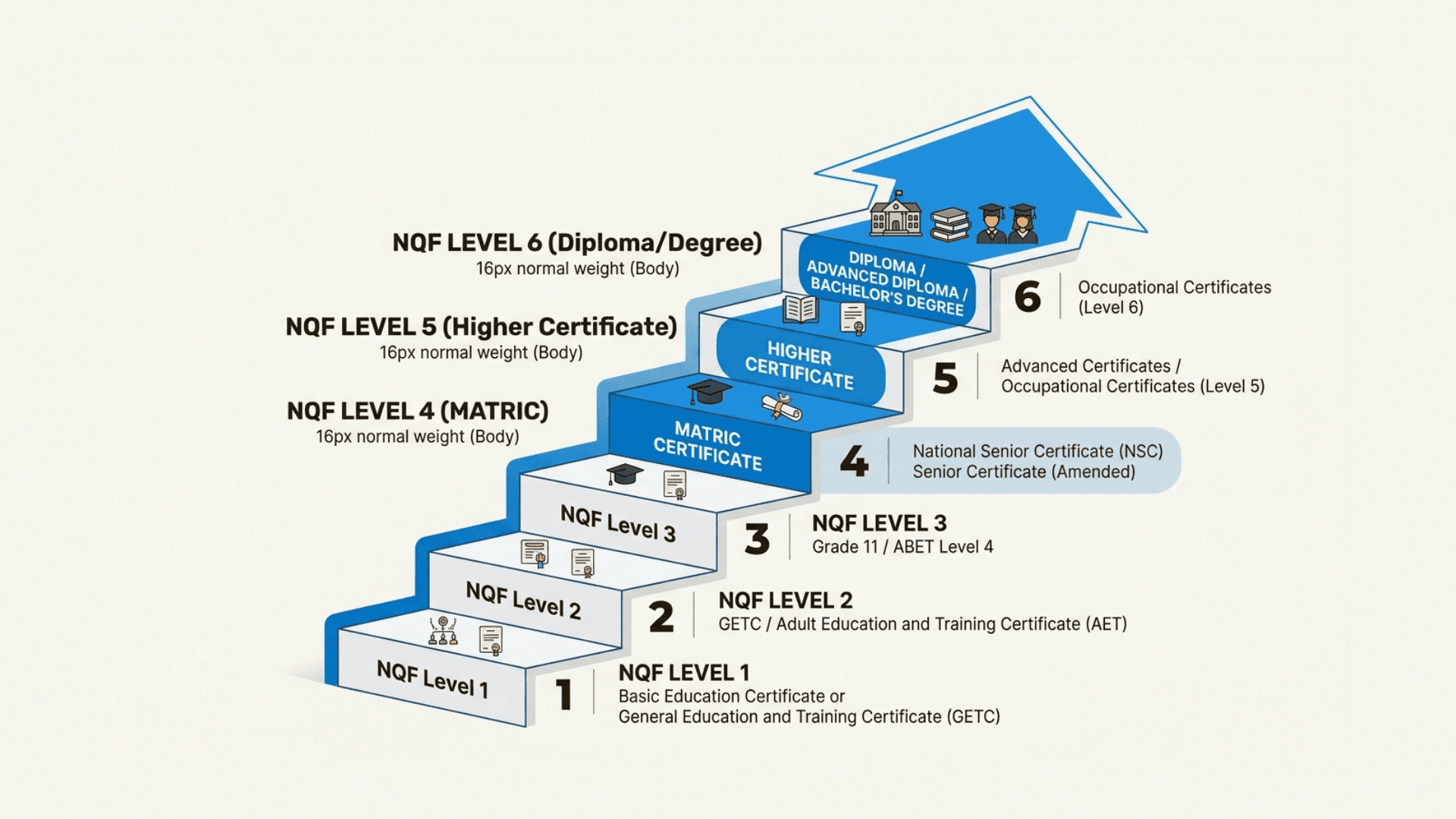
The structure of a learnership is governed by a three-way contract between the learner, the employer, and a registered training provider. This ensures that you are not just used for "cheap labour" but are actually receiving the education promised in the curriculum.
What is an internship?
If a learnership is a "working bursary," an internship is more of a "graduate boot camp." An internship is a short-term work placement specifically designed to give graduates or current students practical experience in their chosen field of study.
The primary focus here is workplace exposure. You already have the theory (from your Degree or Diploma), and now you need to see how it works in a real office environment. Internships are the bridge between university life and the professional world, helping you build the "soft skills" and technical proficiency that recruiters look for.
Most internships in South Africa are aimed at graduates who already hold a higher education qualification. Companies like Vodacom or Clicks often use graduate internships as a primary recruitment tool. They treat the programme as a long-term interview, often offering permanent roles to top performers once the initial 6 to 12-month period is complete.
Unlike learnerships, internships usually do not lead to a new qualification. You are using the credentials you already worked hard for to get your foot in the door.
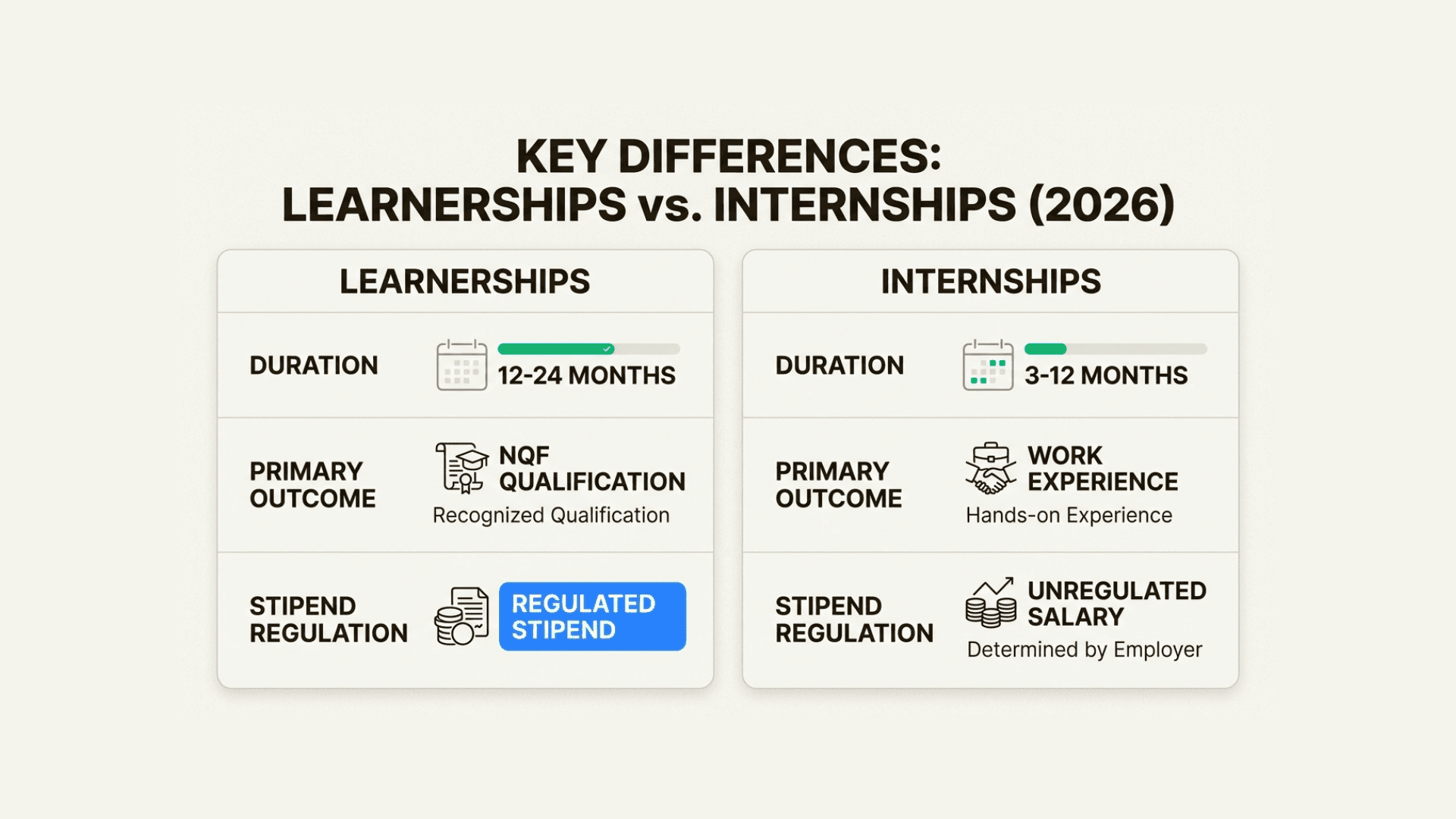
Key differences between internships and learnerships
Understanding the core differences between these two paths is essential for your 2026 planning. While both offer a stipend, the underlying structure and long-term outcomes are quite different.
Qualification vs. experience
The biggest difference is what you walk away with at the end. In a learnership, you finish with a new National Certificate and work experience. In an internship, you finish with work experience and a professional reference, but no new formal qualification.
Financial structure and stipends
This is where things get interesting. Learnership stipends are regulated by the government under Sectoral Determination 5. This law sets minimum allowances based on the NQF credits of the programme. Because the employer is also paying for your tuition fees, these stipends are often lower than internship salaries.
Internship salaries, on the other hand, are mostly unregulated. A small business might offer a basic allowance, while a large bank or tech firm might pay a competitive junior salary.
Feature | Learnership | Internship |
|---|---|---|
Primary Goal | Qualification + Experience | Work Experience |
Entry Requirement | Usually Grade 12 (Matric) | Diploma or Degree |
Duration | 12 – 24 Months | 3 – 12 Months |
Regulation | Highly (SETA & NQF) | Less (Employer-led) |
Outcome | Accredited Certificate | CV Experience |
The "tax secret" (Section 12H)
You might wonder why companies seem so eager to offer learnerships. The answer lies in SARS Section 12H. This tax incentive allows companies to deduct up to R80,000 from their taxable income for every learner they train. If the learner has a disability, that deduction can jump to R120,000. This is why you will often see more learnership opportunities available than traditional internships.

The 2026 roadmap: Which should you choose?
Deciding on the right path depends entirely on where you are in your journey. As you look toward 2026, ask yourself where you stand currently.
For matriculants and school leavers
If you have completed your Grade 12 but do not have the funds for university, a learnership is your best bet. It acts as a "free college" experience where you get paid to learn. Many industries, such as retail and administration, offer excellent learnerships in South Africa that provide a strong groundwork for a career.
For graduates and diploma holders
If you have already spent three or four years studying, you likely don't need more classroom time. You need to get your hands dirty. An internship is the logical next step to convert your degree into a salary. Look specifically for graduate programmes in South Africa that offer structured mentorship and a clear path to permanent employment.
Career stacking
One strategy we often recommend is "career stacking." This involves starting with a learnership to gain a specific technical qualification, then moving into an internship at a larger firm once you have that certificate. This dual approach makes you an incredibly attractive candidate in a competitive market.

Application tips and timelines for 2026
If you want to land an opportunity for 2026, you need to start moving early. Most major companies open their application windows between November 2025 and April 2026.
Here is how the process works:
Research the right SETA: If you are looking for a learnership, check which SETA governs your preferred industry (e.g., BANKSETA for finance).
Prepare your documents: Ensure you have a clean CV, a certified copy of your ID, and your latest academic results.
Verify the opportunity: Scams are unfortunately common in the job market. Always verify opportunities on the official company website or through a trusted platform like ours. We have a dedicated guide on landing work safely in 2025 and beyond that covers exactly what to look for.
Own your career with Spanisam
The 32% unemployment rate in South Africa is a serious challenge, but it doesn't have to be the end of your story. Whether you choose an internship or a learnership, the key is to stay proactive.
We are here to help you every step of the way. You can browse our latest weekly job vacancies or look for specific no matric jobs if you are still working toward your qualifications. Our job listing platform is designed to connect real people with amazing opportunities nationwide.
Don't wait for the right opportunity to find you. Take the first step today and see all job posts currently available on our platform. Your 2026 career starts now.